
What the Iran War Has Taught Us - And What Australia Still Refuses to Learn

One of the first lessons of the Iran war is that modern wars don’t stay “over there” for long. They arrive at your local servo, your supermarket, your freight bill and your household budget long before the government is prepared to speak honestly about what’s happening. And Australia’s learning this the hard way now.
When the bombs first started falling, Anthony Albanese rushed to say Australia supported the action - while trying to maintain the usual political fiction that support is somehow different from involvement. Penny Wong said Australia supported action to stop Iran acquiring a nuclear weapon, but brushed aside the legality question as a matter for Israel and the United States. That might have sounded neat in Canberra. But it’s a lot less clever now as the PM tells Aussie punters to use less petrol, catch buses and brace for months of economic pain.
That’s one of the clearest lessons of this war: if you jump too quickly to back a historic ally, you can end up politically owning consequences you don’t control. Albanese was quick to align himself with the action. He’s been much slower to explain why Australians should carry the cost.
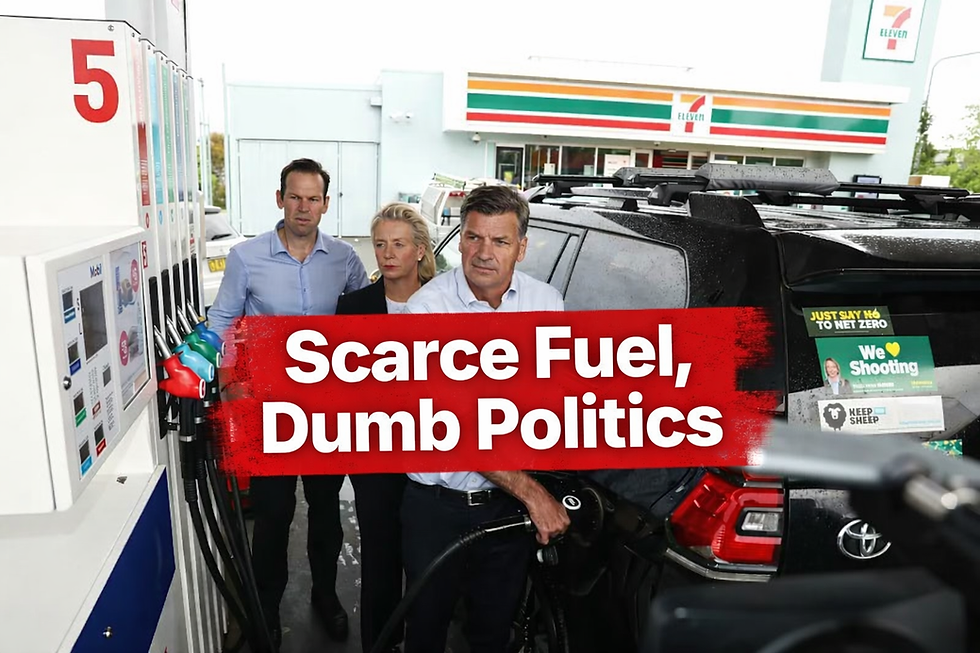
And the costs aren’t abstract. Australia is already seeing shortages, stranded trucks and fishing fleets, regional towns under pressure, and warnings of price spikes flowing through to food and freight. The government has had to halve the fuel excise, release fuel reserves, and activate a national fuel security plan just to steady the ship. Whatever language Canberra used at the start, ordinary Aussies understand the truth: this war is hitting them hard in the hip pocket.
The second lesson is military, and it’s a big one. This war has exposed the absurd economics of 21st-century conflict. The US has reportedly burned through years’ worth of critical weapons stockpiles in a matter of weeks. Analysts estimate more than 11,000 munitions were fired in the first 16 days alone, and warn that systems such as THAAD, Tomahawks and Patriot interceptors are in dangerously short supply. One of the most damning details is the simplest: US-made Patriot missiles costing around $6 million each are being used to shoot down drones worth $60,000. That’s not strategic genius. It is strategic haemorrhaging.
This matters for Australia because it punctures a lot of lazy thinking in our defence debate. We still talk as though prestige platforms and alliance loyalty automatically equal security. But the Iran war shows future conflicts will be decided as much by stockpile depth, manufacturing capacity, supply chain resilience and the cost curve of attrition. A country can have shiny and expensive hardware and still be strategically exposed if it can’t afford the exchange rate of the war it’s fighting.
It also throws a harsh light on AUKUS and our Government’s obsession with sticking with old alliance habits. If elite Western militaries can burn through scarce, high-end munitions this quickly against missiles and drones, then the idea that Australia can simply buy its way to safety through a handful of enormously expensive platforms looks shakier by the day. The future could easily belong less to the side with the most glamorous kit and more to the side with cheaper mass-produced weapons, smarter adaptation, and an industrial capacity to keep going.
The final lesson is political. Public support for war is always easiest when the costs are hidden. It evaporates quickly when people can’t fill their car, are told by the PM to catch buses, and can’t pay their grocery bills. That’s where this war is now landing in Australia. Not in heroic abstractions about allies and resolve, but in the deeply unheroic reality of fuel insecurity, inflation and household stress.
Trump’s Iran war has taught us that modern conflict is asymmetric, ruinously expensive, economically contagious and politically destabilising at home. Australia’s political leaders should have been much more cautious before rushing to support it. And they should be more honest now. Because the old formula - back the ally first, explain the consequences later - is no longer good enough for a world where war reaches the bowser before the spin room has finished drafting its lines.



Thanks, Greg. Yes, the general public are always the ones to take the consequences wars. The Greens are the only party to advocate for War Powers Reform, which they have been doing for decades. Last week, Greens reintroduced their War Powers Reform Bill, otherwise known as: The Defence Amendment (Parliament Approval of Overseas Service) Bill but it was blocked, as always, by the major parties and One Nation. This Bill would have removed the power to send Australian troops into war from the faceless individuals in Cabinet and Executive Government and placed this power, instead, under Parliamentary stewardship.
The full Parliamentary process of both Houses should make this decision. One reason this is so important is that of Public Consent.…