
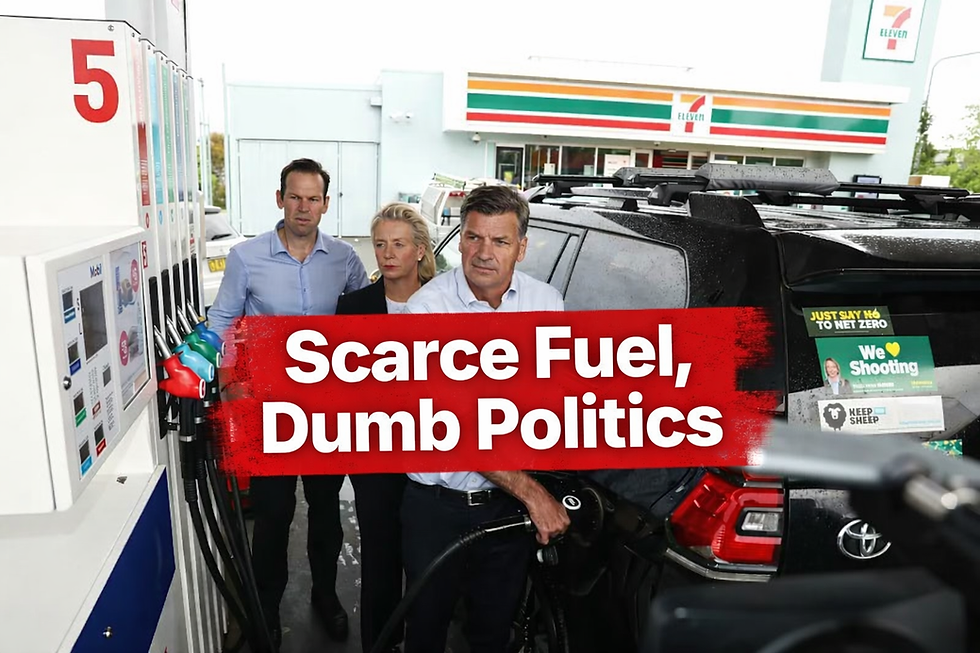
Scarce Fuel, Dumb Politics

As a trained economist, I find one part of Australia’s current fuel debate surreal. Fuel supplies are tightening. Service stations are running dry. Governments are talking about supply disruptions, emergency imports and contingencies for essential users. And into that situation comes the predictable LNP popularist cry: cut the fuel excise. Make petrol cheaper.
It might be a good political sound bite. But it's not smart economics.
When something's in short supply, making it cheaper is an irrational response. Lower prices encourage higher demand. That's basic economics. If fuel is scarce, the priority should not be to stimulate more consumption of it. The priority should be to conserve it for uses that matter most.
And some uses plainly matter more than others. Ambulances matter more. Fire trucks matter more. Freight moving food and medicine matters more. Remote communities relying on diesel generation matter more. Buses that keep cities functioning matter more. Agricultural and other essential services matter more. In any genuine fuel supply crunch, conservation isn't an abstract virtue. It is part of keeping society working. Any rationing framework needs carve-outs for essential users such as emergency services, farmers and public transport. This isn't just about price pain, it is about priority.
So yes, support people who are being smashed by higher fuel prices. Absolutely. But do it intelligently. Give targeted cash relief to low-income households. Support regional workers and small businesses with temporary payments where fuel use is genuinely unavoidable. Back essential freight. Expand school transport. Encourage work from home where possible. And, crucially, make alternatives to driving cheaper or free. But don't give a tax cut to people driving fuel guzzling $180,000 Dodge RAMs.
Victoria has just done exactly that, announcing free public transport unil 30 April to take pressure off the petrol pump. Tasmania has also moved to free public transport. These are much more rational responses than subsidising more petrol consumption during a supply shock. They help households and they help reduce demand for the scarce commodity.
There's another obvious response too: make it easier for people to cycle and use e-bikes. Governments could trial temporary cycle lanes, protected corridors to stations and town centres, secure bike parking, and subsidies or even hire schemes for e-bikes. Like some of the temporary changes during Covid, a crisis response could end up leaving something better behind: cheaper transport, healthier cities and less dependence on imported fuel.
This is where the current debate becomes bigger than excise. It is about the structural vulnerability Australia has allowed to fester. For years, the LNP has treated electric vehicles not as an economic and strategic opportunity but as a culture-war prop. Scott Morrison infamously ran the line that EVs would “end the weekend”, and claimed they couldn't tow your boat or trailer. That wasn't just juvenile politics. It was a serious contribution to delaying a transition that would have made Australia more resilient today.
We don't need to cry too much over spilt milk, but we should at least learn from it. If Australians had been encouraged rather than scared off. If electrification had been framed as freedom from volatile oil markets rather than elite green moralising. If governments had moved faster on charging, fleet transition and public confidence. If buses and government fleets had been electrified more rapidly. Then this fuel shock would still hurt, but not as much.
EVs made up 13 per cent of new car sales in Australia in 2025. Norway, by contrast, reached 96 per cent of new-car sales being fully electric in the same year. That's not a minor difference. That's the difference between a country still highly exposed to imported fuel shocks and one that has insulated much of its transport system from them.
Of course, Australia isn't Norway. Different geography, different vehicle fleet, different politics. But the principle still holds. Every household car, bus, council ute or government fleet vehicle that runs on electricity rather than imported petrol or diesel is one less unit of demand bearing down on a fuel system in crisis. Electrification is climate policy, yes. But it's also cost-of-living policy, industrial policy and national resilience policy.
That's why cutting fuel excise now would be such a mistake. It would treat the symptom in the laziest possible way while worsening the underlying problem. It would spread relief too broadly, including to high-income households that consume more fuel, while doing nothing to reduce structural dependence on imported oil.
Australia needs a more adult conversation. If fuel is short, conserve it. Protect essential services. Support people directly, not by encouraging more consumption of the scarce good. Expand free or discounted public transport. Roll out temporary cycle lanes and back e-bikes. Accelerate bus electrification. Back EV uptake. Build resilience rather than spin.
And perhaps most of all, stop pretending that mocking EVs for seven years was harmless political theatre. It helped leave Australia more exposed than we needed to be. And the bill is arriving now, at the bowser.


hi Greg, I agree with 99% of what you wrote.
I don't think 25c off a $3.30/L of diesel will drive up inflation to any great extent.
The reduction in the fuel excise will cost the Government (us) $2.55 billion, I haven't got the break up in those figures ei. what mining companies, farmers and transport companies will be paying.
But like you say, electrification is the key to energy security. Fortunately, we were able to afford to have a total solar/battery household and EV ( pensioners with some savings we bit the bullet).
I feel for farmers and transport operators but not for coal/gas miners in particular. They should be doing what Andrew Forest is doing, going electrify everything.
Thanks for the clarity Gregory. In a fuel shortage, why should Monster Truck drivers be getting a discount to drive up demand further!
✅
Great summary, Gregory! When fuel is in limited supply it should be prioritised to keep our essential services running and take care of those who can least afford additional expenditure. Unfortunately, too many Australians are adopting the "me first' attitudes we see so widely promoted in some media. That's what leads to them buying gas-guzzlers and behaving in an anti-social manner.
As somebody who has displayed the 'smug, EV owner's grin' since late 2023 I would welcome more people to join me. Subsidies woudl be better for the community if directed towards helping more people into EVs - and home electrification - that giving money to those who already have more than they can sensibly spend.