
If the COPs won’t save us, What will?

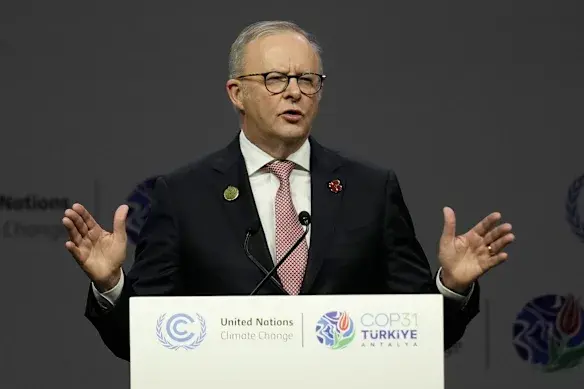
On Saturday 14 November, while negotiators were in Türkiye for COP31, a group of Aussies concerned for a safe climate walked around Lake Burley Griffin with our dogs. That same day in Newcastle, hundreds of kayakers paddled out into the harbour to protest against Australia’s coal exports. By the following weekend, the climate talks had ended without an agreement. Governments couldn’t even agree on what to say about fossil fuels. Australia as leader of the negotiations, put forward an agreement that didn’t even mention them.
In my last two blogs I wrote about the failure of COP31 and the costs and impacts of getting everyone to COP talkfests. Which leaves a fair question: if the COPs won’t save us, what will?
I reckon part of the answer lies in where we look for power. Every November we look for it in a conference hall overseas. Meanwhile, here in Australia, a minister can approve a new gas project or coal mine, a bank can finance it, and a festival or sporting team can sell to a gas or coal company the right to put its name on something we love. Each of those decisions has someone’s name on it. And each gives citizens somewhere to start.
There are more of us than we think
A study published in Nature Climate Change asked nearly 130,000 people across 125 countries what they thought about climate action. Eighty-nine per cent wanted their governments to do more. Sixty-nine per cent said they’d be willing to contribute a share of their income to help tackle global warming. People consistently underestimated how many of their fellow citizens were willing to contribute.
That last finding struck me. If I think I’m the only citizen who’s uncomfortable with a gas company’s logo on sporting jerseys, I’ll probably keep it to myself. If three of us have that conversation, we might turn up at the club AGM and start asking for change.
Something like that happened in the Western Australian arts community. Artists spent years challenging Woodside’s association with Perth’s Fringe World. In 2021 the naming-rights deal ended, but Woodside kept funding the organisation that ran the festival. The artists kept asking questions. By 2024, that partnership had ended too. As an artist, I like the principle here. The goodwill an audience feels at the end of a performance is something the artists earned. They’re entitled to a say in who gets to borrow it.
Another way we can act as s on climate is by changing who we send to Parliament. Here in Canberra, I’ll be mobilising with hundreds of other people at the next federal election to get David Pocock re-elected to the Senate and Jessie Price elected to the House of Representatives. Community-backed independents like David and Jessie listen to the people who elected them and speak up without having to toe a party line. They’re strong on climate action.
A conversation in the middle of the Nullarbor
In 2024, when I rode my bike across Australia for climate action, I met and made a friend Robert Hinkley. It was right in the middle of the Nullarbor. Of all the conversations I thought I might have out there, one about corporations law would have been a fair way down the list. But I’m still thinking about it two years later.
Robert spent 30 years as a corporate lawyer advising big companies and financial institutions. He got me thinking about a pretty basic question. What does a company owe the rest of us, including those of us who’ll never own a share in it?
Under Australia’s Corporations Act, directors have a duty to act in good faith in the best interests of the corporation and its shareholders. Robert wants Parliament to add a few words to that duty. His Code for Corporate Citizenship would put a limit on how directors can pursue the company’s interests. They’d have a legal duty to draw the line where doing so would cause severe harm to the environment, human rights, people’s health and safety, the dignity of employees or the communities where the company operates.
Think about what that could mean at a gas company board meeting. Directors might already ask what climate change will cost their company. Robert’s proposal would require them to also ask what their company’s decisions will cost everyone else. If expanding a gas field will do severe environmental damage, a healthy return for shareholders would not be enough. That’s a change worth fighting for. And the people who can make it? Well they sit in Parliament House.
What does it take to actually close a coal plant?
Another instructive answers comes from Ontario in Canada. In 2003, coal accounted for about a quarter of the province’s electricity supply mix. By 2014, coal was eliminated. Among the people who helped make that happen were nurses, doctors, asthma advocates and clean-air campaigners. They gave people a reason to care about closing coal plants that was as immediate as the air their kids were breathing.
The bit I’d borrow is what happened after the politicians made the promise. Ontario put a closure deadline into regulation. Health groups kept pressing for earlier action. By the 2011 election, all the major parties supported the phase-out. Electricity planners and the public power company had a deadline they could plan around, and voters had a date against which they could judge their government. The last coal plant stopped burning coal in 2014.
Now put yourself in the Hunter. If your wage comes from coal, you’re entitled to ask what work will be available, what it will pay and whether you’ll have to leave town to get it. Those are climate questions too. Unions, councils, Traditional Owners and local businesses should have a say in what replaces coal while there’s still time and money to build it. I’d like to see governments put as firm a date on funding those jobs as they put on closing a power station.
Our young Pacific neighbours have already shown us how
In 2019, 27 law students from eight Pacific island countries had an idea. What if the world’s highest court could be asked to spell out what governments owe people whose homes and futures are threatened by climate change? The students organised across the Pacific.
Vanuatu took up their cause. In July 2025, the International Court of Justice delivered its advisory opinion on states’ climate obligations. An idea that started among students became a question governments around the world had to reckon with.
That’s an important reason I still want international institutions. Imagine telling those students the world court was a waste of time. Equally, imagine telling them to sit tight until a government came up with the idea.
So how do we loosen the fossil fuel industry’s grip on international cooperation? For a start, governments could borrow a rule they already use for tobacco. Under the World Health Organization’s tobacco treaty guidelines, governments must limit their dealings with the industry to what’s needed to regulate it, and make those dealings transparent. Australia could apply that principle to climate policy tomorrow. Keep coal and gas lobbyists off our negotiating delegation and out of Parliament House. Publish who ministers meet and what the companies ask for. Pay for Pacific community representatives and First Nations people to participate on their own terms. A gas company can afford the airfare. A Traditional Owner defending Country from its next project ought to be heard too.
And countries that are ready to phase out fossil fuels can get on with it together. In April, Australia was among 57 countries that met in Santa Marta, Colombia, to discuss how. Tuvalu and Ireland will co-host the next conference in the Pacific in July 2027. I’d like Australia to arrive having already announced an end to new coal and gas approvals and fossil fuel subsidies, with a funded offer to help workers and communities through the transition.
Where I find hope
Three years ago I sat outside Parliament House with my dog Fred on a climate hunger strike. This month I was organising a Dogs for Climate Walk, with Fred and other dogs. I’d recommend the dog walk as the more sociable of the two. But there’s a serious reason I want to do it again. The next time there’s a decision worth challenging, some of us will already know each other. We can turn up together.
And if you’re wondering where to start, I’d start with a decision close enough that you can find out who makes it. When does your club’s sponsorship deal come up for renewal? Would your MP back a change to the Corporations Act that makes companies answerable for severe harm they cause? Is there a community already defending a place you care about that could use your time or skills? You don’t have to start a movement. Often somebody’s already booked the hall and would be really glad to see you.
I still want Australia at the next COP. But between now and then, there’ll be loans signed, projects approved or refused, sponsorships renewed or dropped, and public money committed. We get a say in those decisions if we organise enough to influence them.
That’s where I find active hope. And we’ve got work to do long before anyone boards a plane for COP32.


Hi Gregory, many thanks for your latest important news release. I am happy to say that our community group, based in Goulburn, has a template for connected community action that is self-funding and rives the establishment of a sustainable community. The program started some 7 years ago with regenerative agricuture and we are launching an LGA-wide sustainable households that will reduce energy bills, build the economy and reduce emissions. Our model includes building a network of LGAs based on the internationally adopted OnePlanet framework, starting with building a model of an LGA Ecosystem, that looks at future LGA potential. Whilst we have won an international award, building local support is a bare-knuckle fight every day, as the majority of our…