
COP at what cost?

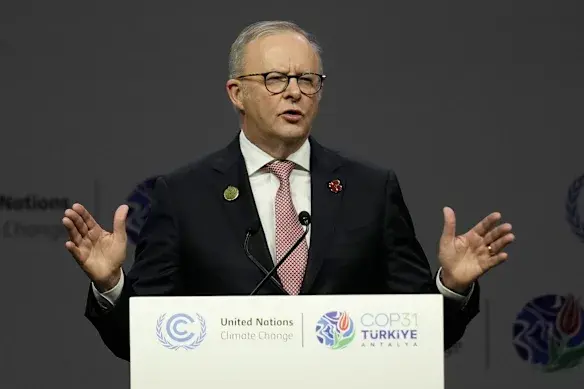
Australia budgeted $147.8 million for its 'leadership' role at COP31 and the Pacific meetings leading up to it. Our climate minister, Chris Bowen, led the negotiations. But the final deal Australia and Türkiye put forward collapsed. The UK, the European Union and others rejected it, in part because it didn’t even name fossil fuels.
So here’s my $148 million question. Next time a coal or gas project lands on Environment Minister Murray Watt’s desk for approval, what difference will any of that have made? My friend Audrey Barucchi, co-founder of People for Nature, asked herself a more personal question when deciding to give COP31 a miss. “Do I need to go, or do I simply want to go?”
As someone who used to help lead Australia’s UN climate negotiations, I reckon that’s a fair question to put to me too. I know why negotiators need to sit across a table from one another. I also know how easy it is, after spending half the night trying to get a sentence into an agreement, to feel like you’ve achieved something the moment everyone agrees to it.
But what counts is whether anyone acts on that sentence when they get home.
The carbon cost of getting there
Audrey shared a study in Communications Sustainability that estimated emissions from flying official country delegates to and from UN climate talks. At the first COP, in Berlin in 1995, those flights generated about 3,000 tonnes of CO₂-equivalent. By COP29 in Baku in 2024, that had grown to nearly 77,000 tonnes. The delegates’ flight footprint at Baku was about 26 times what it had been in Berlin.
Across those 29 conferences, the flights added up to an estimated 710,000 tonnes. That’s roughly the same as emissions from a full year of home energy use, transport and waste for 50,000 Australian households. And here’s the thing. The researchers could count only delegates nominated by countries. That covered just 54 per cent of recorded attendance.
I’d happily defend the cost of flying a Torres Strait Islander to a meeting where their future is being decided. I’d have a harder time explaining to that same person why, after they made the trip, the countries leading the talks put forward a deal that couldn’t bring itself to name coal, oil or gas.
What’s happened to the emissions we went there to cut?
In 1995, the year of the Berlin COP, the world emitted about 23.3 billion tonnes of fossil CO₂. By 2015, when governments adopted the Paris Agreement, that had risen to 34.7 billion tonnes. And in 2025, the latest year for which we have a full year’s data, it reached 38.4 billion tonnes. In the three decades since the first COP, annual global fossil CO₂ emissions have risen by roughly two-thirds. The world is emitting about 15 billion extra tonnes a year.
There’s something worth recognising in those figures. Emissions growth slowed after Paris. And for 2026, the Global Carbon Project estimates that fossil CO₂ emissions could dip by about 0.4 per cent, to 38.2 billion tonnes. Wind and solar are making a difference. And some of this year’s expected drop will also come from lower oil use following the energy shock caused by the Donald Trump's war in Iran. Researchers caution that it’s too early to call a lasting decline.
And once you include land-use change, such as deforestation, total human-caused CO₂ emissions are projected to rise from 42.8 billion tonnes in 2025 to 43.3 billion tonnes in 2026. That’s what makes each year of COP dysfunction so costly. The CO₂ we emit while governments argue over the wording adds to what’s already warming the planet.
What happens when ministers fly home?
We already have an Aussie example. At COP28 in Dubai in 2023, Australia joined nearly 200 countries in calling for a transition away from fossil fuels in energy systems. Less than two years later, in September 2025, Murray Watt gave formally signed off on the massive North West Shelf gas processing plant to keep operating until 2070. That approval will generate nearly four billion tonnes of greenhouse gas pollution - almost nine years’ worth of Australia’s entire domestic emissions. The Albanese government claimed credit for the words in Dubai. The gas industry got it's approval in Canberra.
That’s what I find so dysfunctional about these COPs. A government can help negotiate nice words about a global transition away from fossil fuels, then go home and approve decades more gas processing, and then turn up at the next summit supposedly as a climate leader. Imagine if every returning minister had to stand up in Parliament and name a decision the government would change because of what it had just agreed overseas. I’d tune in for that.
I still believe in the UN. Pacific nations deserve a seat at the table and big polluters owe them the finance to deal with damage they've done the least to cause. But I reckon we give our own government a remarkably easy ride if our scrutiny ends the day the summit does.
Audrey chose to put her energy into Citizen COP and so did I. Here on Ngunnawal Country, a group of us went for a walk near Mount Ainslie and recorded 30 bird species, including a Sacred Kingfisher and a Mistletoe bird. Then more than 120 of us came to the National Library for a film and conversation about nature. And to finish, a group of us and our dogs, including my Fred, took the climate message around Lake Burley Griffin. We'll keep showing up here long after everyone’s handed back their COP lanyards.
The COPs won’t save us. Here in Australia, we elect the government that will decide whether the next big coal or gas project gets federal approval. And now that COP31 is over, Chris Bowen and Anthony Albanese owe us an answer.
When that next proposal lands on Murray Watt’s desk, will he say no?



COP31 each time it is held, drops lower in credibility in my opinion, and now I see it not being the least bit genuine from the outset...set up to fail, with the big money ( the 1%), fossil fuel/mining interests, corporations, billionaires, in the room and the rest of the people (99%) especially Pacific Nations, Indigenous and more vulnerable, poorer communities from the Global South suffering profoundly from the effects of accelerating climate change, outside the room, which is not a forum of equals but a forum of greed and class division.
As for Australia's important organising role at COP31, it clearly fell flat and the script for Albanese and Bowen to read out was obviously written by the too…
This is the best outcome that could have been expected, given that Russia and Saudi Arabia would NEVER agree to phasing out of fossil fuels. It's nothing to crow about but at least there hasn't been a universal agreement to continue the status quo. As the world warms and we see more climate-induced disasters and untimely deaths from heat stroke, hip pockets in certain areas (I'm looking at the US tech bros, Saudi princes and Russian oligarchs) will begin to see the effects of their recalcitrance. It'll be too late for some of us but it's one way to kick-start some remedial action (I hope).
Pretty duplicitous as most things are with this Government. It is going to be hard for any leader of a carbon fuelled economy and resource-rich country like Australia to weave a coherent and credible message out of COP. New gas reserves will be opened which is, paradoxically, part of the transition away from fossil fuels but perhaps the real answer is to tax the gas at 25% and use the extraordinary revenue from it to accelerate the transition to renewables and invest in neglected human capital and services. Now that might make Chris Bowen into a COP leader.
It.was a COP out, that's for sure. What a disappointment, though TBH I'm not surprised. This Labour government has been pathetic when it comes to protecting the environment.
Glad I'm not Chris Bowen.