
While We Look Away, Antarctica is Melting

If you want a metaphor for our times, you could hardly do better than Antarctica in June 2026. While Pauline Hanson argues about migration and pronouns flags, and everyone gets whipped up into culture wars and social media outrage, Antarctica is experiencing temperatures that should be unimaginable
.
Scientists are recording temperatures at some stations above 15°C during the Antarctic winter - when its supposed to be freezing! In some locations, temperatures are 20°C above normal. Researchers are describing rain falling on glaciers and landscapes changing from white to brown and green as snow and ice disappear.
This is not a summer heatwave. This is Antarctica in winter.
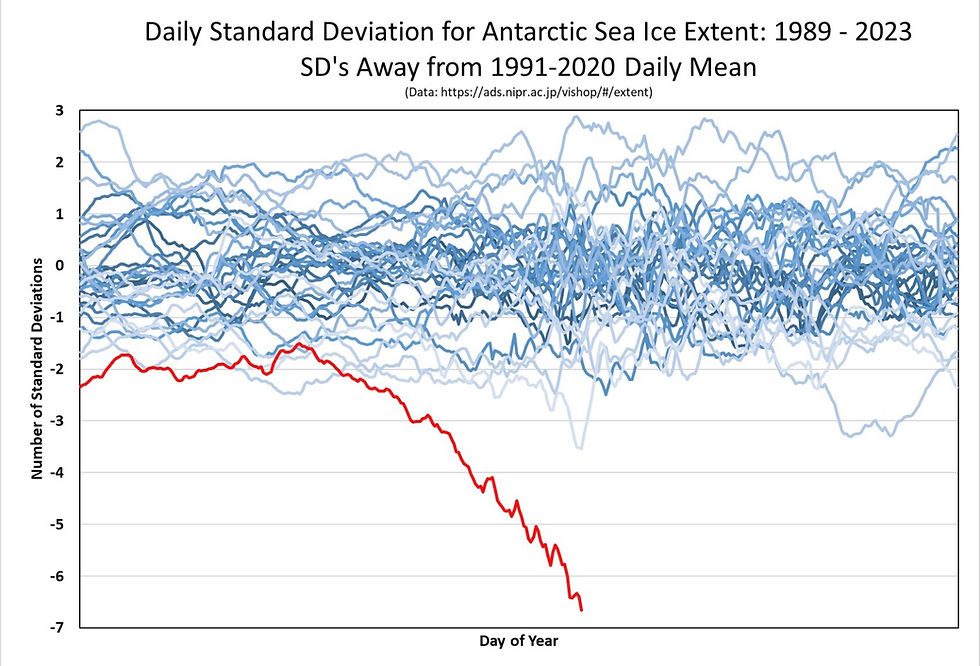
The figures will be scrutinised and some may yet be revised. That’s how science works. But the broader pattern is undeniable. Antarctica is changing rapidly, and it’s sending us warning after warning. Antarctic sea ice has repeatedly reached record lows. Glaciers are retreating faster than scientists expected. Events once described as extraordinary are becoming increasingly familiar. And yet they barely register in public debate. This is not an accident.
For decades, the fossil fuel industry has understood that it doesn’t need to win the scientific argument. It lost that argument long ago. The evidence linking fossil fuels to climate change is overwhelming. Instead, it only needs to delay action, distract us and divide our attention.
The strategy is simple. Create enough noise that people stop listening to the signal. Flood public debate with outrage. Turn citizens against one another. Manufacture endless controversies. Convince people that every issue is more urgent than the climate crisis. Donald Trump has become the global embodiment of this strategy. Every day brings a new controversy, a new outrage, a new distraction. Media organisations chase the latest spectacle because spectacle attracts clicks. Meanwhile, Earth’s atmosphere quietly accumulates more greenhouse gases. The oceans continue to warm. Ice continues to melt. The physics doesn’t care about political theatre.
Carbon dioxide concentrations are now higher than at any point in human civilisation. The laws of thermodynamics are not subject to fossil fuel fascism and culture-war talking points. The atmosphere simply keeps score.
Perhaps the most disturbing thing about the latest Antarctic heat event is not the temperature itself. It is the reaction. Or rather, the lack of it. Imagine if Antarctica had recorded these temperatures thirty years ago. It would have dominated front pages around the world. Today it competes for attention against Trump’s latest outrage, Pauline Hanson’s antics, celebrity scandals and algorithm-driven conflict. We’ve normalised the abnormal.
The danger is not merely that climate change is accelerating. The danger is that our political and media systems have become incapable of responding to slow-moving existential threats. We’re trapped in an attention economy that rewards anger, fear and division while systematically underweighting long-term risk. Antarctica is trying to tell us something.
The glaciers don’t care about election cycles. The oceans don’t care about polling data. The atmosphere doesn’t care about political ideologies. The Earth is changing. Faster than expected. And while the planet sends increasingly urgent warnings, many of the world’s most powerful political and economic actors are working overtime to ensure we look somewhere else.



I find this absolutely terrifying yet our government does nothing meaningful
What on earth ( literally) can we do?
I protest, I write letters, I talk to others, my inbox is flooded by letters from many many environmental groups, asking for donations ( I do) but it is overwhelming, so easy to turn away and put your head in the sand.
In 2014 I spoke to climate scientists about the Arctic jet stream, about how it had become wavy, with above 30 degrees in Alaska and snow in Florida. Could it happen in the southern hemisphere? The consensus was maybe, but probably not. A few years ago the jet stream was not Perth to Sydney, that day it was Darwin to Melbourne. Now we have bursts of cold air streaming up into NSW from time to time. The southern jet stream is starting to behave like the northern one. The difference in temperature between equatorial and arctic regions is now much less in both hemispheres with unpredictable results.
Here in Queensland, Clive Palmer is gearing up as a contender for the next Federal election with his United Australia Party. In an appeal to naive voters, there are all sorts of promises listed in his 'New Deal' pamphlet. In an interview on 10 news, Clive is asked how he will pay for the $2 trill. costs for housing and to end the national debt. Clive's agenda is revealed in his answer, stating that he will abolish the NDIS and Net Zero. On the subject of Net Zero, Clive adds: We've got to put Australians first and our basic needs now, not worrying about 50 or 60 or 100 years in the future, when we won't be on this planet…
I appreciate your emails - and I'm glad to read them so that I have a better understanding of what's happening however I'm struggling with a sense of doom and hopelessness - I'd love it if some of your posts had suggestions on what we can do to help.
The corporate sector now controls the public sector by blocking legislation which would make them stop their destructive behaviour. This problem cannot be solved by additional corporate regulation--30 years of COPs should have taught us that by now. The solution has to be to change the decision making instructions given to all corporations. In other words, the solution lies in changing the rules of coporate governance--not corporate regulation.
Corporate directors are now required to make decisions based solely on "the best interests of their company." In Australia, this instruction is given by Section 181 of the Corporations Act. It needs to be amended to make clear that future decisons in the company's best interests can "no longer come at t…