
How Australia Became The Resource-Rich Country That Acts Poor

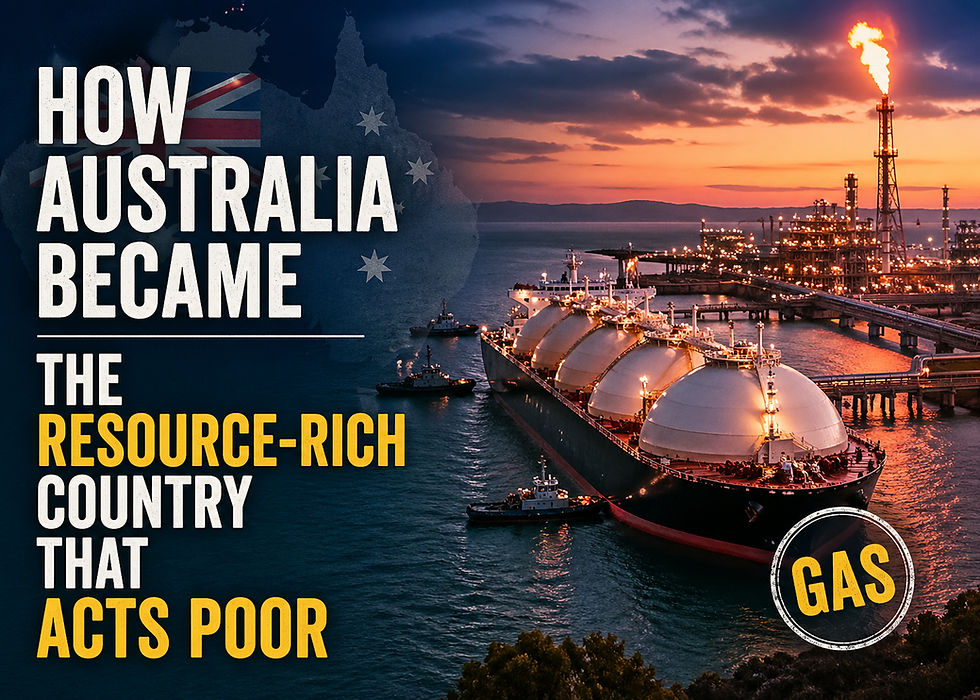
Here’s something I can’t get my head around. Australia is one of the largest gas exporters in the world. We let huge foreign companies pump it up, liquefy it, ship it offshore, and sell at enormous profit into global markets. But somehow, as a country, we act like we’re poor.
That’s not rhetoric. That’s the numbers. The tax we collect from this industry is tiny. Aussies pay more more in beer excise each year than the gas industry pays in royalty taxes. And students’ university fees contribute more to the federal budget than the gas industry does. That should stop us in our tracks. It says everything you need to know about how upside down the system has become.
Because Aussie gas under the ground isn’t owned by multinational companies. It belongs to us. It’s a public resource. And when it’s extracted and sold, the punters should be getting a fair return. But we’re not.
And now even the people who designed the system are saying so. Former Treasury Secretary Ken Henry turned up at Parliament House this week to say we should be taxing gas more. And renowned economist Ross Garnaut made a similar call. Despite all of this, Anthony Albanese is sitting stubbornly on his hands - resisting meaningful reform even as the evidence piles up and the calls for change grow louder.
So what’s going on? Part of the answer is structural. The Petroleum Resource Rent Tax sounds sensible on paper. Tax profits, not production. Let companies recover their costs before paying tax. Encourage investment. Fine.
But in practice, it’s been gamed by the mining industry. Creative accounting and complex corporate structures blur where the money is really made and allow the industry to engage in massive tax avoidance. The result is an industry exporting tens of billions of dollars’ worth of gas while paying very little tax for years on end.
That’s not a glitch. That’s the system working exactly as it has been designed and allowed to. And that’s why the deeper question isn’t economic. It’s political. Because governments have known about this for years.
The real reason nothing changes goes back to 2010. When the Rudd Government tried to tax mining profits properly, the industry didn’t just lobby. It went to war. Advertising blitzes. Political pressure. Leadership destabilisation. The LNP ganged up with them, and they won. Every government since then has absorbed the lesson. Don’t take on the resource sector.
So instead of structural reform, we get tweaks. Adjustments. Reviews. Language about “balancing investment certainty” with “community expectations”. Meanwhile, the underlying problem rolls on.
There’s another layer too. It’s linked to Australia’s fossil fuel diplomacy. A lot of this gas is exported under long-term contracts to countries like Japan and Korea. So public servants and people influencing our government argue that changing the rules will make Australia unreliable. That it will spook investors. That it will create sovereign risk.
But here’s the thing: super rich countries like Norway and Qatar export gas too. Norway has turned its resources into a trillion-dollar sovereign wealth fund. Qatar has built one of the richest economies on Earth off the back of gas. And here’s the kicker - Australia exports more LNG than Qatar, yet captures only a fraction of the value. They tax the resources heavily. They capture the wealth. They invest it for future generations. They haven’t scared off investment.
Which brings us to the uncomfortable truth. Australia isn’t failing to tax gas because it’s too hard. We’re failing because we’ve chosen not to. We’ve chosen to prioritise politics and laziness over economic fairness and prosperity. We’ve chosen to accept industry arguments about jobs and investment at face value. We’ve chosen to let largely foreign-owned companies extract public resources and return none of the value. And we’ve normalised it. Anthony Albanese even used the gas industry’s own talking points this week to justify his inaction.
That’s the part I struggle with most. Not the economics. The acceptance. Because if this were any other policy area, we’d fix it ASAP. If Coles or Woolies were taking billions out of the community and paying almost nothing back, we’d be outraged. If a foreign company was making a mint from the Sydney Opera House, Uluṟu of the Great Barrier Reef and giving nothing back, we’d demand change. But with gas, we shrug. Or worse, we defend it.
And that’s where this starts to feel a lot like AUKUS. Big numbers. Big strategic narratives. Very little scrutiny of whether the public is actually getting a fair deal. In both cases, we’re told it’s about the national interest. But whose national interest, exactly? Because right now, it doesn’t look like it’s the Australian public.
Fixing this isn’t radical. It’s standard practice. It’s the things people like Senator David Pocock are calling for. A stronger resource tax. A modest export levy. Closing the loopholes that allow profits to be deferred indefinitely. Greater transparency about what’s being sold and what’s being paid.
None of this would make Australia uninvestable. It would just make it fairer. And that’s really the point. We’re a wealthy country sitting on valuable resources. Acting like we’re not is a choice. The question is how much longer we keep making it.


I've become a bit of a fan of the person who writes as " I fucking love Australia" it's not your alter ego is it?
Exactly, so. Australia's gas and oil are public resources that belong to all. Yet the profits go to just 1% of the Australian community: super-wealthy mining tycoons that pay next to no tax. According to the Australian Institute, mining contributes around 6% of federal government revenue. But when you include all governments in Australia, mining contributes only around 3% of all revenue. https://australiainstitute.org.au/post/big-profits-but-dont-be-suckered-into-thinking-mining-dominates-australias-economy As Larissa Waters states: Gas export tax of at least 25% would raise around 17 billion each year, that could be used to ease cost of living pressures and invest in essential services." https://greens.org.au/magazine/built-1-paid-rest-us
While it's a nice idea in theory, Australian politicians (particularly on the Labor side) wouldn't be able to resist spending it at some point. Norway's Future Fund explicitly says it does not invest (or at least invest only minimal amounts) in Norwegian stocks in order to stop Norway's economy overheating and causing massive inflation.
Jim Chalmers, on the other hand, has already directed Australia's Future Fund to direct investment in Labor's investment desires within Australia - infrastructure, housing and renewable energy amongst other things. While some of these things might return a profit, some probably won't thereby wasting money on poor investments and contributing to inflation; reducing the amount of money for public servant pensions.
I think it was Best summed up how appalling the situation is is when Shell chair of Australia was asked simple questions during a senate inquiry on Wednesday like how much gas did you export last year and she couldn’t answer it. Because if she lied, she would be in contempt so she just pleaded ignorance. All she had to do was pick up a phone and she could google it. On the upside I think I might start applying for the top jobs in the fossil fuel industry cause apparently the skill set required is minimal
As usual this article is spot on. However, the bigger problem is that the world is still investing massively in oil and gas exploration and extraction. The science is clear that fossil fuels must be phased out to the greatest extent possible as quickly as is responsibly possible. This is not happening.