
“From the River to the Sea”: Why Banning a Phrase Is a Bad Idea
- Gregory Andrews

- Apr 22
- 3 min read
There’s something deeply unsettling about a government deciding that a particular political phrase is illegal to say. Not because the phrase is harmless. It isn’t. It’s contested, provocative, and emotionally charged. But that’s precisely why banning it is a mistake.
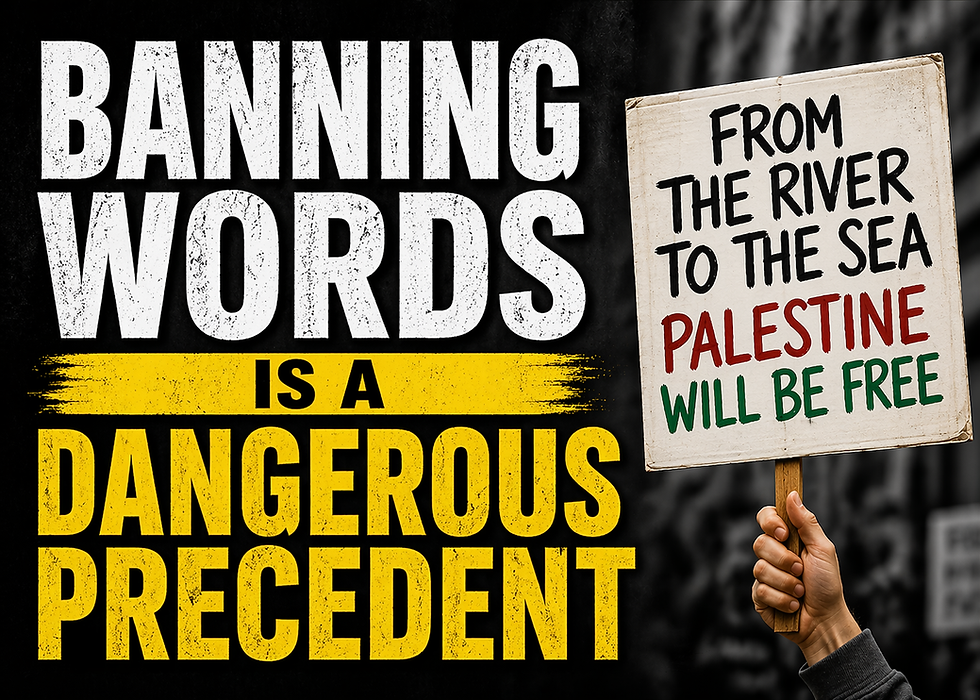
This week in Queensland, people were arrested for displaying the phrase “from the river to the sea.” One of them was a Jewish man, wearing a shirt calling for a free Palestine. That fact alone should give us pause. Because it exposes the central flaw in the law: it assumes the phrase means one thing. It doesn’t.
For some, it’s heard as a call for the destruction of Israel. That concern is real and shouldn’t be dismissed. Words can intimidate. They can wound. In the wrong context, they can incite. But for many, it’s a call for Palestinian freedom and equal rights across the land between the Jordan River and the Mediterranean Sea. It’s a call for freedom from the apartheid and genocide being perpetrated by the state of Israel. That’s also real. And speaking out against it isn’t a act of violence. Indeed, for me it’s the opposite.
By criminalising the phrase itself, Queensland collapsed these meanings into one. It stopped distinguishing between hatred and advocacy, between threat and belief. That’s not just clumsy. It’s dangerous. Because once states start fixing the meaning of words, they’re no longer policing harm – they are policing thought. And that’s Orwellian.
Let’s take the hardest version of the argument. Even if the phrase implied a single Palestinian state across the whole territory – even if it challenged the existence of Israel – should that be illegal? In a liberal democracy, the answer should be no. We ban incitement to violence. We ban threats. We ban harassment. But we don’t usually ban political ideas. You don’t have to agree with a view to defend someone’s right to express it. In fact, that’s the whole point of free speech.
There’s another problem here too. Australia is a secular, pluralist society. We don’t – or shouldn’t – single out one conflict, one religion, one country or one set of political grievances for special restrictions on speech. Yet that is what this law does.
There’s no equivalent list of banned phrases for other religions, other wars, other causes, or other contested histories. If the test is that a phrase causes offence or fear, then almost any political slogan could be next. I find a lot of the things that Pauline Hanson says offensive. But that doesn’t mean they should be criminalised.
And this leads us to the most telling moment of all: a Jewish man arrested under a law designed to combat antisemitism. That shows how blunt it is. Because if a phrase can be used by antisemites, by human rights activists, and by Jewish critics of Israeli policy, then banning the phrase itself is a crude solution to a complex problem.
None of this is to deny that harm exists. There are people who use these slogans to intimidate. There are contexts in which they are threatening. There are situations where they cross the line into incitement. But we already have laws for that. If someone threatens, charge them. If someone incites violence, prosecute them. If someone harasses, act.
Target the conduct. Prove the intent. Demonstrate the harm. But don’t criminalise a phrase and hope that justice will sort itself out. Because that’s lazy at best. And this debate is about something much deeper than Israel or Palestine. It’s about whether governments should have the power to ban political language because of what they believe it represents.
Today it’s this phrase. Tomorrow it could be another. A free society doesn’t require us to agree. It requires us to tolerate disagreement – even when it’s uncomfortable.
Actually, especially then. Because the alternative isn’t safety. It’s oppression.


It is ironic that the Government of Israel, on its current path, will more likely achieve a 'one state solution' from the river to the sea. In words and actions over many years it has shown its intention to expand its territory to encompass both the West Bank and Gaza. The astonishing brutality towards the Palestinians conveys a consistent policy message: lesve, or submit to subjugation.
Laws banning freedom of speech are autocratic, hypocritical and discriminatory. Palestinians are semites, yet these same laws are not applied on their behalf, nor to those standing on their behalf against genocide. The far right have decided that decades of apartheid and the ongoing torture and murder of babies, children and humanity in Palestine is a lesser evil than speaking up for human rights. Our collective defence of humanity and the preservation of human rights should be beyond all political divides. No matter what party politics we may engage with or believe in, upholding human rights is the duty of us all.
I strongly agree with your comments. I live in Queensland and am having to put up with a far right government with several ministers who are not too bright!
You are absolutely correct - we should not be banning words or phrases, no matter how offensive. But I believe that the Australian public has decided that the do want to be protected from offensive words and phrases, hence legislation like 18C etc.
If we can't offend people based on their race, then we shouldn't be allowed to call for global terrorism (Globalise the Intifada), or to call for the genocide of Israelis/Jews (From the river to the sea, Palestine will be free).
This banning of the phrase From the River to the Sea is obviously the work of the Zionist lobby. But it's ok for them to use it - I've heard Benjamin Netanyahu use it! The public is wise these days to the machinations of various lobby groups. We're tired of seeing our politicians doing the bidding of these groups - rather than what we want, the people who put them in government.