
Bird Flu Has Landed - and Australia’s Wildlife Has Nowhere Else to Go

The virus is unavoidable. But an extinction crisis should not be.
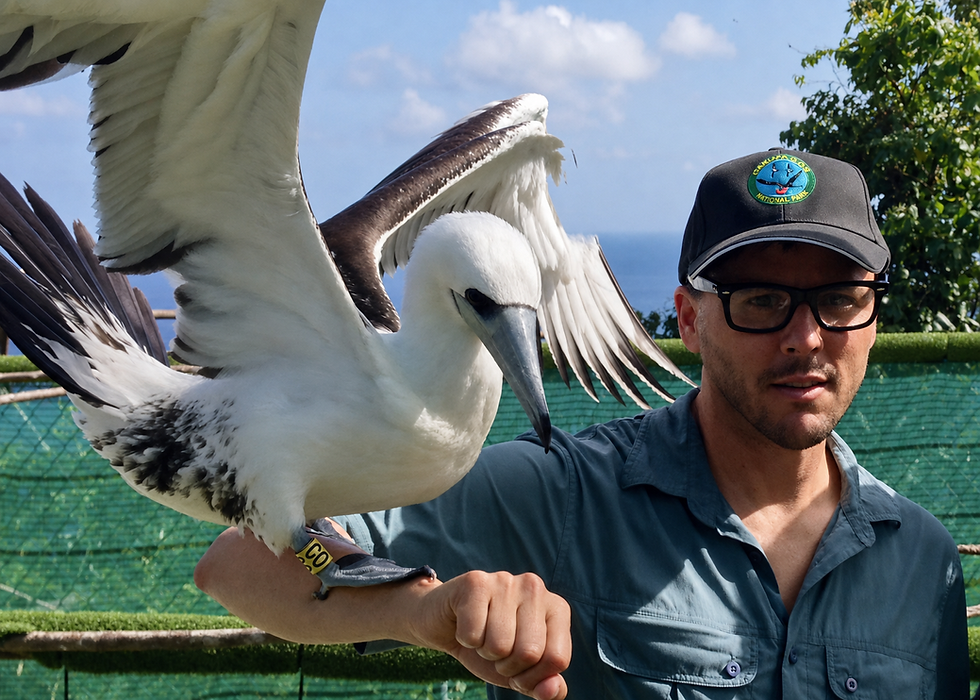
This is me on Christmas Island back in 2014, when I was Australia’s Threatened Species Commissioner, meeting an endangered Abbott’s booby. Sorry about the name. This Abbott has done nothing wrong! But joking aside, that photograph now carries a significance I couldn't have imagined at the time. The Abbott’s booby nests in only one place on Earth: the rainforests of Christmas Island. It's long-lived, slow to mature and can generally raise a chick successfully only once every two years.
Australia’s new H5 bird flu risk assessment classifies the Abbott’s booby as being at very high national risk from the virus. There's no second breeding population waiting safely elsewhere. There's no spare Abbott’s booby colony. And that, in miniature, is the danger now facing Australia’s wildlife.
We can't quarantine the sky. We can't stop every migratory bird carrying a virus across an ocean. We can't vaccinate all wild birds. But we can stop bird flu from becoming the final blow for Australian species already weakened by habitat destruction, invasive predators, pollution and climate change.
Bird flu is no longer on its way
H5N1 bird flu was first confirmed on mainland Australia in June 2026, after a sick brown skua was found in Cape Le Grand National Park on Western Australia’s southern coast. But Australia had already received a terrible warning. In late 2025, H5N1 was confirmed on Heard Island, an Australian sub-Antarctic territory about 4,000 kilometres southwest of the mainland. Subsequent surveys estimated that approximately 13,000 southern elephant seal pups died - around 76 per cent of all pups born on the island. Penguins and Antarctic fur seals were also infected.
As I write this on 14 August, the national bird flu dashboard records 186 confirmed wild-bird events across Western Australia, South Australia, Victoria, NSW and Queensland. Tasmania has also just confirmed its first infected bird. More importantly, officials have found evidence of local transmission in South Australia and Victoria, as well as Australia’s first bird-flu mass-mortality event. Infected native birds have included greater crested terns, silver gulls, a cormorant and an Australian magpie. One infected tern was found near Wentworth on Wiradjuri Country in far western NSW - a disturbing sign that the virus is no longer exclusively a coastal problem.
This is no longer a handful of unlucky migratory birds washing ashore. H5N1 is now moving through Australian wildlife. There have still been no detections in commercial poultry or the wider agricultural system, and the risk to human health remains low. That's reassuring. But it shouldn't distract us from the emerging biodiversity emergency.
What exactly is bird flu?
Bird flu is caused by influenza A viruses that primarily infect birds. There are many different strains, ranging from those that cause little illness to highly pathogenic strains capable of causing severe disease and sudden death. The strain now spreading in Australia is H5N1 clade 2.3.4.4b.
Infected animals shed the virus through saliva, droppings, respiratory fluids and feathers. It can spread through water, mud, sand, clothing, footwear and equipment. In suitable conditions, it can also remain in the environment for months. This particular H5N1 strain is extraordinary because it escaped the boundaries of poultry farms and spread through wild animal populations around the planet. It has infected hundreds of bird species and numerous mammals, including seals, sea lions, dolphins, foxes, cats, dogs and cattle.
Why did Australia escape for so long?
Australia has experienced bird flu before. Several outbreaks involving H7 strains have occurred in poultry and have been successfully eradicated. What we had avoided until now was this globally devastating H5N1 strain establishing itself in wild birds.
One important reason is that no duck species routinely migrate between Australia and Asia. Ducks can carry H5N1 over long distances without becoming too sick to fly, making them particularly effective vehicles for its spread globally. Australia’s relative isolation from duck migration routes initially helped protect us.
But the virus kept evolving and expanding its range. It moved through South America, reached Antarctica and then spread between sub-Antarctic islands. Skuas, petrels and other wide-ranging seabirds effectively took over the long-distance carrier role. And that's how the virus eventually reached us - from the south. Geography bought Australia time. But it didn't give us immunity.
What's likely to happen now?
We don't know precisely which species will be hit hardest or how many animals will die. Aussie wildlife is unique, and many of our birds and mammals have never encountered anything like H5N1. But we do know the broad direction of travel.
Scientists expect more spread, more species to be infected and more mass-mortalities. Wildlife Health Australia has already warned that H5N1 is likely to become an ongoing wildlife disease - not a short-term event that can be eradicated from wild populations. Seabirds, waterbirds and shorebirds are particularly exposed because they gather in large numbers and share water, nesting grounds and feeding areas. Spring and summer will be an especially anxious period as birds congregate to breed and raise their young.
Black swans, pelicans, magpie geese, ducks, grebes, cormorants, terns and penguins are among groups known to at risk. Birds of prey and scavengers - including eagles, falcons, gulls and ravens - may also be infected when they hunt weakened animals or feed on carcasses.
Then there are the mammals - because, yes, H5N1 affects more than birds. Australian sea lions and fur seals gather in colonies and share habitats with seabirds. Tasmanian devils, quolls, dingoes and rakali may encounter the virus by scavenging infected animals. Platypuses will be affected because they share waterways with birds. The deaths on Heard Island thus demonstrate that calling this “bird flu” can dangerously understate its reach.
The Australian Government has assessed more than 2,000 native bird and mammal species. Nearly 400 are considered at high, very high or extreme national risk. Five island-breeding bird species are rated at extreme risk, meaning they may be unlikely to survive wherever the virus occurs.
The impact won't be uniform. A common, widely distributed species may suffer a catastrophic local die-off but survive nationally. But for a threatened species with a small population, one breeding location or a very slow reproductive rate, the same outbreak could become an extinction event. That's why the Abbott’s booby matters.
This is also a Caring for Country crisis
As a D’harawal man, I don't see this simply as a veterinary or agricultural problem. The health of animals, people, ecosystems and culture is interconnected. For First Nations peoples, affected wildlife may be family, totems, food, stories, ceremony and living expressions of Country. Species such as magpie geese and muttonbirds have profound cultural significance.
Traditional Owners and Indigenous rangers will therefore need frontline roles in surveillance, planning and decision-making. They know their Country, its seasons, its animals and when something is wrong. They should be empowered to lead responses - not just informed afterwards.
What governments must do
The Australian Government has committed $113 million to bird flu preparedness, including more than $47 million for native wildlife. Targeted vaccination of priority native birds in captivity is beginning. Australia has strengthened surveillance, protected captive breeding populations and prepared plans for vulnerable species and important sites.
But vaccines are not a silver bullet. Birds require two doses, making widespread vaccination of wild populations extraordinarily difficult, if not impossible. Vaccines can help protect insurance populations in zoos, wildlife sanctuaries and managed breeding programs, but we can't vaccinate every wild swan, tern, penguin, booby or platypus.
The best defence is strong, healthy and widely distributed wildlife populations. That means governments must protect and restore habitat, control invasive predators, reduce disturbance at breeding sites, adequately resource surveillance and carcass management, and fund recovery after mass-mortality events. Species and site-response plans should be publicly available wherever genuine biosecurity considerations allow.
Conservation organisations are calling for an additional $200 million for wildlife resilience over the next two years. Given the scale of the threat, that's entirely reasonable. And perhaps most importantly, governments can't claim to be building bird-flu resilience while continuing to approve habitat destruction and underfunding threatened-species recovery. A population already hanging by a thread has little chance of surviving the arrival of another major threat. Preparedness has to be more than plans and press conferences. It must mean healthier Country and more animals alive in the wild.
What you can do
If you encounter sick or dead birds or other wildlife, remember: Avoid. Record. Report. Don't touch, move, bury or attempt to rescue the animal. Keep children and pets away. Record the location and what you can see, take photographs or video from a safe distance. Report it to the 24-hour Emergency Animal Disease Hotline on 1800 675 888.
You can also help by:
Keeping dogs leashed around beaches, lakes, rivers and wetlands.
Keeping cats indoors or securely contained.
Cleaning birdbaths on your garden regularly.
Cleaning footwear, clothing and equipment before moving between wetlands, reserves or agricultural properties.
Keeping backyard poultry food and water away from wild birds.
Supporting habitat restoration and demanding proper investment in wildlife recovery.
The Abbott’s booby has already survived extensive phosphate mining, forest destruction, cyclones, wind turbulence and invasive yellow crazy ants. It shouldn't be left now to face bird flu with almost no margin for further loss. Neither should our swans, penguins, sea lions, platypuses, devils or the hundreds of other species potentially standing in the virus’s path.
We can't quarantine the sky. But we can strengthen the Country beneath it. H5N1’s arrival may have been inevitable. An extinction crisis is not. #FloraAndFaunaFriday


Thank you, Greg, for providing these important biosecurity measures and for your words: “Governments can't claim to be building bird-flu resilience while continuing to approve habitat destruction and underfunding threatened-species recovery.” As a wildlife volunteer, I second those truest of words and I also call out what I see as the constant and ongoing siege of warfare against Australian native fauna and flora species, at every level of government, in clearing vegetation and prime wildlife habitat. I have a special connection to glossy black cockatoos. These ancient, free-spirited birds rely upon several varieties of casuarinas for foraging and the nesting hollows of old-growth eucalypt species for breeding. I love the primal sound of their calls and I make a point…
"We can't quarantine the sky. But we can strengthen the Country beneath it!"
Another great big "thank you", Gregory, for a very informative and necessary article. I share most of your information - the Biodiversity Council gave a very clear webinar on 09/07/2026.
I feel that your article gives more to more people in explaining the connection to Country and also the basic measures that we all must take.
Oh! how I wish that our governments were much more prepared to fund and give a say to the Aboriginal and Torres Strait Islander communities on the Countries that, as you write "they know".