
Australia’s Crocodile Tears in the Pacific

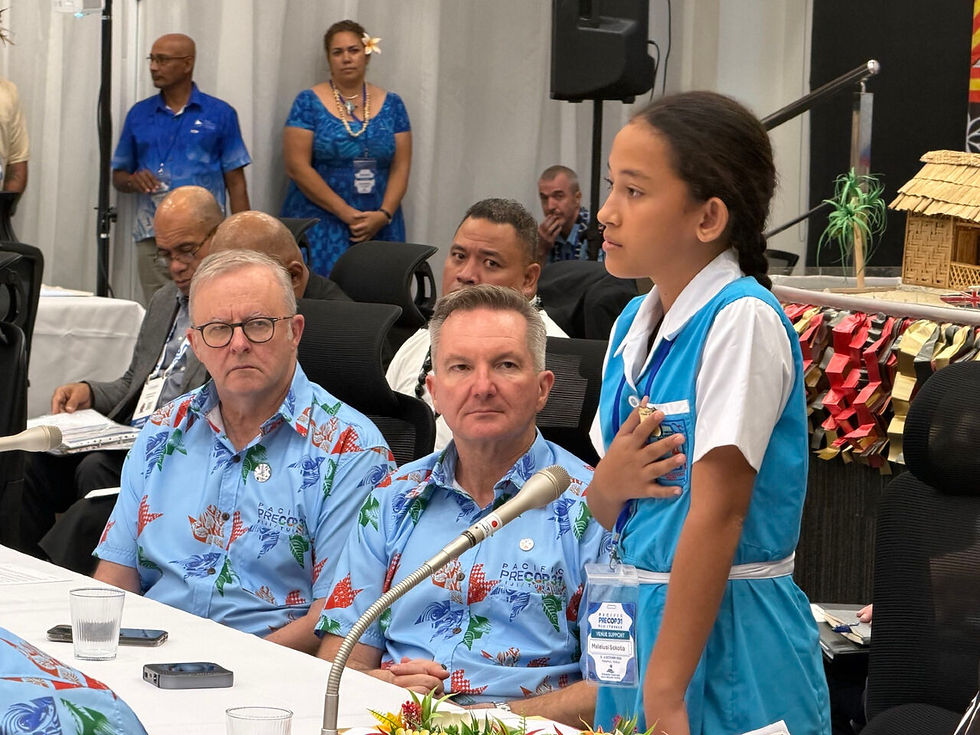
Anthony Albanese’s social media is currently full of the Pacific. Photos from Tuvalu. Pacific leaders in floral blue shirts. Smiling children. Listening faces. Blue water surrounding islands whose future is threatened by rising seas.
“Climate change isn’t a future challenge for the Pacific. It’s a daily reality,” Albanese posted from Tuvalu this week. He also declared that the Pacific is on the “front line” of climate change and that for some island nations it represents a threat to their very existence.
He’s right. And that’s precisely what makes Australia’s behaviour so difficult to stomach.
Because while our Prime Minister spins climate empathy stories in the Pacific, his government continues facilitating expansion of coal and gas industries like there’s no tomorrow. That isn’t climate leadership. It is the central contradiction at the heart of Australian climate diplomacy.
Listen to the Pacific - but actually listen
Foreign Minister Penny Wong has been making much the same pitch. In Fiji she urged the world to “come to the Pacific” and see for itself the reality of climate change. Australia says its diplomacy is designed to elevate Pacific voices and put Pacific priorities at the centre of global climate negotiations. Great. So what are those Pacific voices actually saying?
Tuvalu’s Prime Minister Feleti Teo warned fossil-fuel expansion by countries such as Australia represents a “death sentence” for his country. Vanuatu Climate Minister Ralph Regenvanu said the very least Australia should do is stop expanding fossil-fuel production.
That’s the bit Canberra seems less enthusiastic about hearing. Listening to Pacific children describe climate change is important. But listening means more than nodding and posting the photograph afterwards.
The other Australia
There’s another Australia that doesn’t appear in the Pacific selfies. In September last year, the Albanese Government gave final approval for Woodside’s North West Shelf gas processing project to keep operating until 2070 - twenty years beyond Australia’s own net-zero deadline.
By February this year, the Climate Council counted 35 fossil-fuel project approvals under the Albanese Government. The Australia Institute says almost 100 new coal and gas projects are under development in Australia.
And last week, the Hunter Valley Operations coal expansion was approved at the NSW level, potentially generating about 809 million tonnes of greenhouse pollution through to 2045. But there was one encouraging development. While Albanese was in the Pacific talking about climate impacts, the High Court delivered a landmark judgment over the coal mine expansion, finding fault with the way its enormous downstream - or Scope 3 - emissions had been dealt with. The message matters because the law recognised that you cannot simply pretend the emissions from Australian coal disappear when the ship leaves Newcastle.
The atmosphere has never recognised the distinction between emissions produced here and Australian fossil fuels burned overseas. Perhaps our governments should stop pretending it does.
These are not rounding errors. Australia’s own Climate Change Authority estimates that the coal and gas we export generate more than one billion tonnes of CO₂ overseas each year - more than twice our domestic emissions. Climate Analytics puts Australia’s wider fossil-fuel export footprint at around 1.2 billion tonnes annually.
The atmosphere, as I have written before, doesn’t care which country’s spreadsheet the emissions appear on. Coal dug up here and burned in Asia, heats Tuvalu too.
Climate policy in one hand, fossil fuels in the other
To be fair, Labor has introduced some real climate policies. Australia now has a 2035 target of reducing domestic emissions by 62–70 per cent below 2005 levels, renewable energy is growing, and we’re financing renewable energy, adaptation and resilience projects in the Pacific.
But that makes the contradiction harder to explain, not easier. This is no longer old-fashioned climate denial. The Albanese Government accepts the science. It talks about 1.5°C. It acknowledges existential threats to Pacific nations. It funds adaptation. Then it keeps expanding the supply of the fossil fuels causing the problem.
The International Energy Agency’s net-zero pathway is unambiguous: no new long-lead-time oil and gas developments, and no new coal mines or mine extensions, are necessary for achievement of net zero by 2050. You can’t indefinitely reconcile that with approving fossil-fuel infrastructure lasting to 2070.
This is fossil-fuelled diplomacy
Penny Wong doesn’t personally approve coal mines or gas projects. But as Foreign Minister she’s selling Australia’s climate credentials abroad while serving in a government pursuing continued fossil-fuel expansionism.
That’s the problem. Australia is effectively offering Pacific countries money to strengthen coastlines against rising seas while continuing to dig up and export the fuels raising those seas. We help pay for the seawall while keeping the carbon pipeline open.
The Australia Institute and Australian Conservation Foundation were so appalled by this contradiction that this week they bought a full-page advertisement in the Fiji Times, apologising to Pacific nations for Australia’s continuing coal expansion. I’m sorry too.
And that should embarrass Canberra far more than any hostile question at a press conference. I’ve been writing for years that Australia can’t seriously claim climate leadership while expanding coal and gas. In 2023 I wrote that our fossil-fuel exports had to end. More recently I argued that physics doesn’t respond to political spin. Nothing happening in Tuvalu this week changes that argument. It just makes it more urgent.
Anthony Albanese is right to listen to Pacific children. Penny Wong is right to ask the world to listen to Pacific nations. Now Australia needs to listen too. Because the Pacific doesn’t need our crocodile tears. It needs us to stop making the problem worse. And by the look on this girl’s face, she’s not impressed!👇🏽


Excellent article - simply to the point.