
Art as Escape. Art as Resistance

Why I make art to escape the world - and to change it.
Sometimes I make art to escape the world. Other times I make it because I want to change the world. And increasingly, I'm discovering that the two aren't mutually exclusive.
For much of my life, I've worked to protect nature, tackle climate change, advance First Nations rights and stand up for social justice. I've done it through diplomacy, advocacy, public policy, community engagement and occasionally a bit of troublemaking. Much of that work has involved words. Speeches, submissions, negotiations, reports, meetings, emails and, of course, blogs like this one.
But sometimes words aren't enough. And sometimes, frankly, I just need a break from them.
Finding another way to express myself
This year I began a Diploma of Visual Arts at the Canberra Institute of Technology. It's been an opportunity to step outside my professional world, get my hands dirty, learn new skills and experiment with different ways of seeing and expressing things. I've been painting, sculpting, carving, making prints and working with materials I might otherwise have thrown in the recycling bin.
I've made mistakes. I've discovered techniques I love and others I'm still trying to get my head around. And I've found enormous pleasure in simply creating something.
There's something deeply satisfying about losing yourself in a painting, carefully carving a woodblock or transforming an old wheelbarrow into a sculpture. Hours can disappear. The emails can wait. The news can wait. Donald Trump, Anthony Albanese, Pauline Hanson can wait. Sometimes art is simply about enjoying beauty, colour, texture and form. And that's enough.
When art becomes activism
But the environmentalist, First Nations advocate and human rights campaigner in me is never very far away. Art has always been a powerful way to challenge injustice, question authority, tell stories and inspire change.
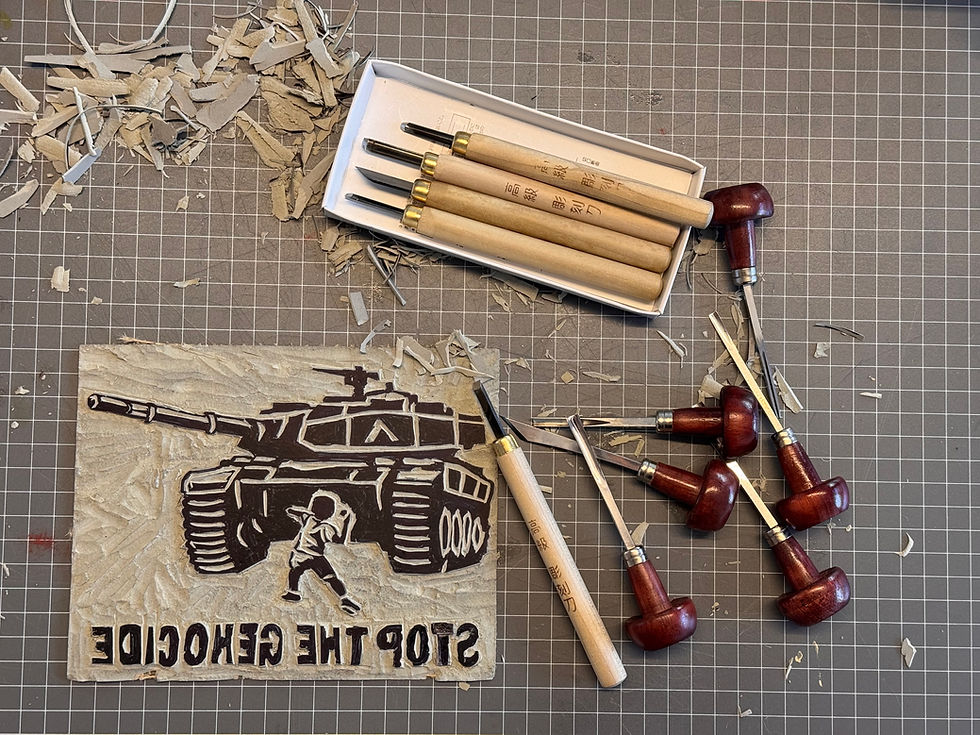
There's even a word for it: artivism. The intersection of art and activism. And I've discovered that it's something I'm drawn to. One of my recent works is Stop the Genocide, a linocut depicting a young boy standing defiantly in front of a tank. Inspired by the iconic image of resistance in Gaza, it speaks to the suffering of civilians and the courage of those who resist oppression. I produced 18 prints. Each one carries the same message, but each is also slightly different, reflecting the handmade nature of printmaking.
Another work, No Vacancy, featured the critically endangered Orange-bellied Parrot. It's a statement about the destruction of habitat and the growing number of species being pushed towards extinction.
Then there's Always Was, Always Will Be, my latest sculpture made from an old wheelbarrow, incorporating painting, kangaroo skin, paperbark and a small bird that I found in an Op Shop. It's a reflection on Country, colonisation, resilience and the enduring connections of First Nations peoples to land and culture.
These works aren't intended simply to look attractive hanging on a wall or sitting in a gallery. They're intended to make people think. Perhaps feel uncomfortable. Perhaps ask questions. And hopefully, sometimes, act.
Beauty is worth defending
Not all my artworks carry an overt political message. I've also spent many happy hours painting, drawing and printing birds, wallabies, rainforests and Australian landscapes.
As a former Threatened Species Commissioner and lifelong birdwatcher, I'm naturally drawn to wildlife. I love the extraordinary colours of our parrots, the character of a Gang-gang Cockatoo, and the subtle beauty of the Australian bush.
But even these works have a deeper meaning for me. We're living through a biodiversity crisis. Species are disappearing, habitats are being destroyed, and climate change is making the challenge of protecting nature even harder.
Yet it's difficult to convince people to protect something they don't know or love. Art can help bridge that gap. A painting of a bird might inspire someone to look more closely at the birds in their own backyard. A landscape might remind someone of a place they treasure. An artwork might help us appreciate something we otherwise take for granted.
Appreciation can lead to care. Care can lead to action.
Sometimes celebrating the beauty of nature is itself a form of resistance against its destruction.
Art, Country and responsibility
As an Australian of share European and Aboriginal descent, I also see art as another way of exploring relationships with Country, culture, history and responsibility. First Nations peoples have used art to share knowledge, tell stories, maintain cultural connections and express identity for tens of thousands of years.
My own artistic journey is still relatively new. I'm learning, experimenting and finding my voice, informed by my identity, my experiences and the things I care about. I don't feel the need to put every work into a neat category. Some pieces are political. Some are personal. Some celebrate nature. Others are simply experiments with technique, materials and colour.
And sometimes, a painting's just a painting. That's part of the joy of art. It doesn't always need to justify its existence.
Art that gives back
I've recently launched a new Art Gallery on my Lyrebird Dreaming website, where I'm sharing some of my paintings, prints, sculptures and other creative experiments. Selected works are available for purchase, and I've decided to donate 50% of the sale price of every artwork to the Indigo Foundation.
The Indigo Foundation is an Australian not-for-profit organisation that works alongside grassroots communities internationally to advance human rights, tackle poverty and support locally led development.
I like the idea that something I create for pleasure, or to express an idea, can also contribute directly to making a difference in people's lives. It's another way to connect art with action.
Art reminds me of the importance of curiosity, experimentation, creativity and play. It gives me a welcome escape from the relentless stream of bad news, political arguments and environmental challenges that so often dominate my days. And it gives me another way to speak about the things that matter. Perhaps that's what I love most about artivism.
Come and see what we've been creating
From 25-27 November, my fellow students and I will be exhibiting our work at Canberra Institute of Technology. It's shaping up to be a wonderfully diverse exhibition, featuring paintings, prints, sculptures and mixed-media works exploring everything from Caring for Country and wildlife to food, family, identity and multicultural Australia.
One of the things I've most enjoyed about studying art has been seeing the extraordinary creativity of my fellow students. We bring different backgrounds, experiences, perspectives and talents to the studio. And it shows in our work.
I'd love you to come along, meet some of the artists and enjoy what we've been creating. The exhibition details and invitation here.
Art can help us escape the world as it is, while inspiring us to imagine - and create - the world as it could be.
You can explore my work, and enquire about purchasing selected pieces, in my online art gallery. Half of the sale price of every artwork goes to the indigo foundation.


Congratulations, Greg! May your Powerful Art and your Wise Words continue to inspire us all.
Thanks Gregory, so refreshing to read and see a dedicated activist and change-maker like yourself also taking time to nurture your creativity and then share with us how this is also an effective pathway to inspiring people to care for nature and humanity.
This is just wonderful, wonderful story and and the artworks are amazing!